
Bicultural Identity in Latino Kids: The Complete Evidence-Based Therapist's Guide to Tools That Work
12 min read
Evidence-based approach to bicultural identity therapy with Latino children. Includes research, clinical frameworks, and 8 ready-to-use tools for therapists, counsellors, and school psychologists.
Something a school counsellor said to me recently has been stuck in my head.
She works with a lot of Latino kids, many of them second-generation, navigating Spanish at home and English everywhere else. And she said:
"I do all the culturally competent things. I learn about their background, I'm respectful, I don't make assumptions. But honestly? I still feel like I'm just kind of gesturing at the cultural piece. Like it's this big thing in the room that I acknowledge but never actually touch."
I think about that a lot. Because there's a difference between acknowledging that cultural identity matters and actually making it the subject of the work. Most therapeutic tools—the worksheets, the card decks, the structured activities—don't help clinicians do the second thing.
That gap is what sent me down this research rabbit hole. And what eventually led me to build a toolkit specifically designed for bicultural kids and families.
What Is Bicultural Identity? Why Therapists Need to Understand This Now
Before diving into the research, let's define what we're actually talking about, because "bicultural identity" gets used loosely.
Bicultural identity refers to a person's psychological connection to and experience within two cultural systems—in this case, heritage culture (e.g., Latino/a/x) and national culture (American). You can know about both cultures without integrating them. The real work happens in how those identities fit together in someone's sense of self.
This matters clinically because research shows it's protective. Strong bicultural identity acts as a measurable buffer against discrimination, depression, and academic struggles. Strengthening bicultural identity moves beyond cultural competence into active clinical treatment.
What Four Decades of Research Actually Say About Biculturalism
Someone sat down and reviewed 152 studies on biculturalism among US Latinos, spanning 1980 to 2020. The central question: is holding both your heritage culture and American identity good for you, or does it create conflict?
In 78% of studies, the answer was clear: it's protective.
Better psychological health. Better physical health. Better academic outcomes. Better resilience.
But here's what makes this clinically useful: researchers have identified at least four distinct dimensions of how biculturalism actually works:
Dual-Cultural Identity: Simply identifying as both Latino and American. The basic acknowledgment.
Bicultural Identity Integration (BII): How well those two identities fit together in your sense of self. This is the critical variable. Some kids experience their two worlds as compatible and enriching. Others feel constant tension, code-switching between two separate selves depending on context. Longitudinal research shows kids with high integration have significantly better mental health outcomes.
Bicultural Competence: Not just having two identities, but having the skills to actually function in both cultural systems. Understanding unwritten rules. Managing competing demands. Knowing when and how to navigate between worlds. This is learnable. This is what therapy can build.
Acculturation Stress: The pressure kids experience when adapting to a new culture, especially when parents and children adapt at different rates. This is where things get harder. Discrimination is linked to lower academic achievement, higher depression rates, and lower self-esteem in Latino adolescents. Unaddressed acculturative stress in families fractures relationships and increases anxiety across generations.
The clinical takeaway: you're not just working with identity. You're potentially working with stress, integration, and skill-building simultaneously.
The Ethnic-Racial Socialization Framework: What Actually Protects Kids
There's solid research on what researchers call Ethnic-Racial Socialization—basically, the strategies parents (and therapists) use to prepare children for life as members of a racial or ethnic minority.
Four main approaches get identified:
Cultural Socialization: Transmitting heritage, pride, traditions, language.
Preparation for Bias: Explicitly preparing kids for discrimination they may encounter.
Promotion of Mistrust: Teaching wariness of people outside the ethnic group (sometimes protective in high-discrimination contexts, sometimes limiting).
Egalitarianism: The "we're all equal, race doesn't matter" colour-blind approach.
The data is unambiguous: Cultural Socialization and Preparation for Bias are the most protective. Kids who know their heritage and have realistic expectations about discrimination show better mental health outcomes.
The colour-blind approach leaves kids less prepared and more vulnerable. The irony is worth noting.
And then there's the Cultural Wealth Model. Rather than looking at deficits, this framework identifies the assets Latino families actually carry:
Familismo: Tight family networks, mutual support, collectivist values
Linguistic Capital: Bilingualism as a cognitive and social strength, not a limitation
Navigational Capital: The skill of moving through systems that weren't designed for you
Aspirational Capital: The ability to maintain hope and vision despite barriers
This reframe changes how you do therapy entirely—you're working with actual strengths, not trying to fill holes.
The Problem With Culturally Neutral Tools (And Why It Matters)
Here's the honest clinical take.
Most mainstream therapeutic tools are designed to be culturally neutral. The intention is good. In practice, this means culturally Western worksheets built on individualistic assumptions, emotion tools that skip collectivist values, psychoeducation centred on white, middle-class norms without naming it.
A bilingual kid walks in. You hand them one of these tools. The work feels surface-level. You're both going through motions.
Ethnic identity functions as a genuine protective buffer against discrimination. This is empirically documented across longitudinal studies. Which means anything you do to strengthen a kid's connection to their cultural heritage—helping them hold both worlds with pride rather than conflict—is protective clinical work.
The tools need to be built with culture at the center, not at the margins.
Clinical Callout: The Integration Question
When assessing a bicultural adolescent, try this single question:
"Does it feel like your two worlds fit together, or does it feel like they're kind of in conflict?"
You don't need the academic language. Just ask the question. The answer will surface years of unspoken tension or show that the integration is working and that you can move forward. This one question is often more clinically useful than longer cultural histories.


The Tools I Built (And Why Each One Matters)

This is what the research pushed me toward. Not just understanding this clinically, but having something to hand clinicians that actually works.
The Multicultural Conversation Card Decks


The card format is deliberate. Clinicians kept saying they wanted to open cultural conversations but didn't know how to without it feeling like checking a box. When the question belongs to the card rather than the therapist, the dynamic shifts. Kids who feel scrutinised respond differently, they're just answering a card, not being interrogated.
Kids' Deck (Ages 6-17)

My Culture & Heritage set opens with low-stakes prompts: "What food from your culture makes you feel most at home?" and "Is there a saying or proverb from your culture that has stayed with you?" These generate rich material about cultural connection and pride without requiring a formal cultural biography.
My Two Worlds set goes deeper into bicultural experience: "Do you ever feel like you live between two worlds? What does that feel like?" and crucially, "Is there a moment when your two worlds felt like they fit together perfectly?" That second card is doing BII integration work—inviting the client to access experiences of cultural coherence rather than only focusing on tension.
The card I think is most underrated: "What language do you speak at home? How does it feel to switch between languages?" Research on bilingual emotional processing shows emotions are often experienced differently across languages. Childhood languages carry deeper emotional weight. Processing in a second language feels qualitatively different. Asking how it feels to switch opens a door most standard tools never get near.
Adult Deck (Ages 16+)

Similar terrain but deeper. Cards about what clients want to pass on from heritage culture, how their identity has shifted over time, and critically: "Have you ever felt pressure to hide or downplay your cultural background?" Therapists report that when they use that card, clients sometimes go quiet. Because they've been waiting years for someone to ask.
Usage: Effective in individual therapy, group work, and school counselling. Bilingual kids often respond better to card-based work than direct questioning.
Accordion Fold Art Therapy Booklets
These came from a different need. Kids with immigration stories often have a significant, formative experience that rarely gets addressed therapeutically. It's either treated as background information and filed away, or it surfaces clumsily without structure.
The accordion fold format produces a small, foldable book. The child assembles it, draws in it, writes in it, and takes it home. It becomes theirs. Worksheets get filed away. Books get kept. That distinction matters.

Psychoeducational Handouts Pack (Four Versions)
Because the work doesn't happen in your office alone. You often need to bring surrounding adults in.
For Children: Explains bicultural identity, why switching between languages is normal, what discrimination is and that it's not their fault.
For Parents: Addresses common fears (language loss, identity confusion), explains why cultural socialization is protective, provides specific practices.
For Teachers: Helps them recognize acculturation stress in the classroom, understand why a bilingual kid might code-switch, provide culturally responsive support.
For School Counsellors: Deeper dive into bicultural identity integration, acculturation stress, referral indicators, collaboration with therapists.

These aren't meant to replace clinical conversations. They're meant to build informed allies around the kid.
Clinical Implementation: How to Use This in Practice
This Week: Two Specific Actions
Action 1: Ask About Language Explicitly
Not as a demographic data point. As a clinical question.
"What language do you think in?" or "What language do you use when you're really upset?" will get you clinical material you didn't know existed. Bilingual kids have often never been asked this in a therapeutic context. You'll learn something about emotional processing, sense of self, and cultural connection you wouldn't have accessed otherwise.
Action 2: Introduce Bicultural Identity Integration
Ask whether the client's two worlds fit together or feel like they're pulling in opposite directions. That one question can surface years of unspoken tension, or reassure you the integration is happening well and you can focus elsewhere.
This Month: Building Implementation
Week 1: Introduce one card deck to a bilingual client.
Notice what emerges that wouldn't have with standard questions.
Week 2: Choose one accordion booklet to introduce.
Let the child know they're making a book to take home (frame matters).
Week 3: Bring a psychoeducational handout to a parent or teacher meeting.
Notice the shift in the conversation when they understand the research.
Week 4: Reflect on what you learned. Which tool fit best with which kids? What surprised you?
Common Implementation Barriers (And How to Address Them)
"I don't have time to introduce new materials."
Start with the conversation cards—they replace your opening question, not add to the session. Often faster than your current opening.
"The kids in my school don't see themselves reflected in Latino-specific tools."
The bicultural identity and immigration story resources translate across any bicultural context—second-generation kids from any background, internationally adopted children, third-culture kids. The frameworks work; you may adjust specific cultural references.
"I'm not Latino/a/x myself. Will this feel inauthentic?"
Cultural humility matters more than cultural matching. What matters is your genuine curiosity, willingness to follow the client's lead on their own experience, and your commitment to learning. Kids recognize that.
Clinical Callout: Cultural Humility Matters
Before you introduce these tools, spend 15 minutes reflecting:
What's your own relationship with cultural identity?
What assumptions do you hold about "American culture" vs. heritage cultures?
Where did you learn those?
Bringing some self-awareness to this work makes everything that follows more grounded.
What the Research Actually Predicts
There's a phrase in the literature that I keep returning to: cultural identity as a buffer. Not metaphorically.
Measured longitudinally, replicated across studies, with real effect sizes.
When kids have a strong, affirmed sense of who they are culturally, when both of their worlds get named and valued, they are demonstrably better protected against the harm of discrimination and bias.
They show:
Lower depression and anxiety scores
Better academic achievement
Higher self-esteem and sense of belonging
Greater resilience when facing discrimination
Stronger family relationships (when parents also have cultural affirmation)
Which means every time a therapist creates space for a bilingual kid to talk about what it feels like to switch languages, every time a card deck opens a conversation that wouldn't have happened otherwise, you're doing something that matters. You're building protection.
About the Bicultural Identity Toolkit

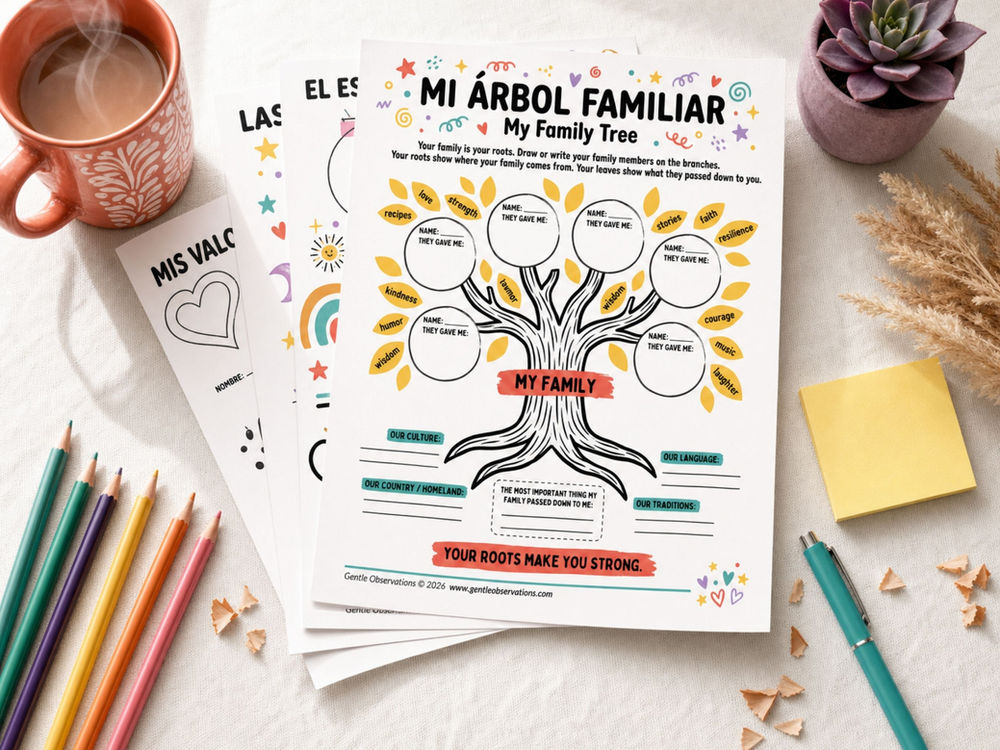
The complete Bicultural Identity Toolkit for clinicians working with Latino and multicultural kids includes:
Kids' Multicultural Conversation Card Deck Printable, cut-and-use cards across themes: My Culture & Heritage, My Two Worlds, Who I Am, My People & Belonging. Ages 6-17. For individual therapy, groups, school counselling.
Adult Multicultural Conversation Card Deck Deeper prompts across the same themes. For individual and group therapy with adult clients navigating bicultural identity, acculturation stress, belonging.
Accordion Fold Art Therapy Booklets (Set of 4)
My Immigration Story: My Family's Brave Journey
My Two Worlds
My Feelings About Being Different
Who Do I Belong To?
Each is a portable, keepable mini-book the child assembles and takes home. Ages 5-14.
Psychoeducational Handout Pack Separate versions for children, parents, teachers, and school counsellors. Printable, shareable, evidence-based.
All resources are available in the Therapy Resource Library.
New evidence-based tools drop every Monday: [Join the Library]

 Latinx Family Art Therapy$6.00Buy Now
 Latinx Psychoeducation Handouts$4.00Buy Now
 Latinx Accordion Fold Art Therapy Worksheets$4.00Buy Now
 Latinx Kids Affirmation Booklets$2.00Buy Now
 Latinx Adult Dual Identity/Ethnicity Conversation Cards$3.00Buy Now
 Latinx Kids Dual Identity/ethnicity Conversation Cards$3.00Buy Now
Free Resources for Therapists
Additional clinical downloads, including free worksheets and handouts, are available in the Gentle Observations FREEBIE LIBRARY.

All resources and every other clinical tool across every major presenting theme are available inside the Therapy Resource Library.
New resources drop every Monday: [JOIN THE LIBRARY]
Frequently Asked Questions
What is bicultural identity integration, and why does it matter clinically?
Bicultural identity integration (BII) refers to how well a person's two cultural identities fit together in their sense of self. People with high integration experience their heritage and national identities as compatible; those with low integration often feel split or in conflict. Research consistently links higher integration to better psychological wellbeing, which makes it a useful clinical concept. You don't need the term with clients—just ask whether their two worlds feel compatible or pulling apart.
How do I bring up cultural identity in therapy without it feeling tokenising?
The card format genuinely shifts this. When a question belongs to the card rather than directly to you, it changes the power dynamic. You're both looking at the card together. Beyond that, follow the client's lead on specifics (food, language, family practices, particular traditions) rather than asking broad questions like "tell me about your culture." Specificity signals genuine curiosity; generality reads as box-checking.
What is bicultural identity integration, and why does it matter clinically?
Bicultural identity integration (BII) refers to how well a person's two cultural identities fit together in their sense
Can these tools work with kids who aren't Latino?
Absolutely. Bicultural identity and immigration story resources translate across any bicultural or multicultural context: second-generation kids from any background, internationally adopted children, third-culture kids who grew up between countries, adolescents navigating significant cultural transition. The research backbone draws heavily from Latino-specific studies, but the clinical frameworks (ethnic identity development, acculturation theory, bicultural identity integration) apply broadly.
What age ranges are these designed for?
Kids' conversation cards: ages 6-17. Accordion booklets: ages 5-14 (My Feelings is best for younger end; My Immigration Story for older kids). Adult deck: ages 16+. All tools are flexible based on developmental level and presentation.
Can I use these in group work?
Yes. The conversation cards are particularly effective in group settings—they create shared prompts without putting any one group member on the spot. Accordion booklets can be adapted for group art therapy work, with
I'm not sure if acculturation stress is what's presenting. How do I know?
Look for: family conflict that centres on language use or different rates of adaptation; academic decline or anxiety after immigration/major cultural transition; code-switching that feels uncomfortable or forced; identity confusion ("I don't fit anywhere"); anxiety around discrimination; physical symptoms tied to cultural stress. Ask directly: "When your family talks about being American vs. [heritage culture], what happens?" The answer usually clarifies whether acculturation stress is a component.
A Final Thought
Every time I see a therapist make cultural identity central rather than peripheral, I think about that school counselor who said she felt like she was "just gesturing" at the cultural piece.
She had the intention. She just didn't have the structure. And structure matters.
The tools don't do the work alone. You do. Your curiosity, your willingness to sit with complexity, your commitment to not reducing a kid's experience to a single identity. But the tools give you something to hold onto.
They make it concrete. They signal to kids that this part of their life isn't background information. It's the subject.
And that changes things.
References:
Safa, M.D. & Umaña-Taylor, A.J. (2019). Biculturalism and adjustment among U.S. Latinos: A review of four decades of empirical findings. Advances in Child Development and Behavior, 56, 213-260.
Berry, J.W. (1997). Immigration, acculturation, and adaptation. Applied Psychology: An International Review, 46(1), 5–34
Phinney, J.S. (1992). The Multigroup Ethnic Identity Measure: A new scale for use with diverse groups. Journal of Adolescent Research, 7(2), 156–176.
Schwartz, S.J., Zamboanga, B.L., & Jarvis, L.H. (2007). Ethnic identity and acculturation in Hispanic early adolescents. Journal of Early Adolescence, 27(3), 335-363.
Hughes, D., Rodriguez, J., Smith, E.P., Johnson, D.J., Stevenson, H.C., & Spicer, P. (2006). Parents' ethnic-racial socialization practices: A review of research and directions for future study. Developmental Psychology, 42(5), 747–770.
Umaña-Taylor, A.J., Kornienko, O., McDermott, E.R., & Moti, N. (2014). Ethnic identity and discrimination in early adolescence: Examining contextual correlates. Child Development, 85(5), 2090-2108.
Benner, A.D. & Kim, S.Y. (2009). Experiences of discrimination among Chinese American adolescents in the context of economic stress. Developmental Psychology, 45(5), 1491-1501.
Yosso, T.J. (2005). Whose culture has capital? A critical race theory discussion of community cultural wealth. Race Ethnicity and Education, 8(1), 69–91.
Benet-Martínez, V. & Haritatos, J. (2005). Bicultural identity integration (BII). Journal of Personality, 73(4), 1015–1050.
Kuperminc, G.P., Wilkins, N.J., Roche, C., & Alvarez-Jimenez, A. (2009). Risk, resilience, and positive development among Latino youth. In F.A. Villarruel, G. Carlo, J.M. Grau, M. Azmitia, N.J. Cabrera, & T.J. Chahin (Eds.), Handbook of U.S. Latino Psychology (pp. 288-306). Sage Publications.
Malchiodi, C.A. (2011). Handbook of Art Therapy (2nd ed.). Guilford Press.
Dreby, J. (2012). The burden of deportation on children in Mexican immigrant families. Journal of Marriage and Family, 74(4), 829–845.