
Addressing Attention-Deficit/Hyperactivity Disorder In The Workplace.
9 min read
Adults With ADHD Are Already In Your Therapy Room, You Just Might Not Know It Yet
There's a pattern that keeps coming up in conversations with therapists in my community.
A client has been struggling at work for years. Missed deadlines, conflict with a manager, that horrible stuck feeling where they know exactly what they need to do and absolutely cannot make themselves start it. They've been told they're not living up to their potential. They've internalised it. They come to therapy for work stress, or burnout, or low self-esteem, and therapy is helpful, but something doesn't quite click into place.
And then, somewhere along the way, ADHD comes up.
And everything rearranges.
The research on adult ADHD and workplace functioning has been building for a while now, and what it keeps showing is something therapists need to know: adults with ADHD face real, measurable consequences at work. Lower earnings, higher job turnover, more absences, more conflict with colleagues. These aren't just anecdotal patterns. They show up consistently.
But what jumped out to me most, looking across the research, wasn't the outcomes. It was the mechanism. And it was the finding that this isn't just a problem for people who know they have ADHD.
The Undiagnosed Problem
One study that I found particularly striking looked at adults with elevated ADHD symptoms who had never received a formal diagnosis, and compared them to people with a clinical diagnosis. Their workplace functioning was essentially comparable. Both groups showed similar difficulty concentrating, similar problems with organisation and time management, similar workplace friction.
Which means that if you work with adults who describe themselves as chaotic, or unreliable, or perpetually behind, you're quite possibly already working with ADHD. The diagnosis just hasn't happened yet. Or ever.
This matters because the frame changes the work. A client who understands they have a dopamine regulation difference has a very different therapeutic starting point than a client who's been quietly convinced for twenty years that they're lazy and undisciplined.
What ADHD at Work Actually Looks Like
The clinical picture of adult ADHD in a workplace setting is worth sitting with, because it reads differently than the childhood version most of us learned about.
It's not a kid bouncing off the walls. It's email overwhelm and inbox paralysis. It's the email they've been drafting for three days. It's losing the thread of what they were doing the moment a colleague stops by their desk. It's post-lunch slump followed by a late afternoon sprint that makes them feel like a fraud the next morning because they can't explain why it worked yesterday and won't work today.
It's the shame after a productive day that felt fake.
And underneath all of it, there's something researchers call the activation gap. The space between intending to do something and actually doing it. For most people, that gap is small and relatively easy to cross. For people with ADHD, it's wider, and the brain needs something specific to bridge it: novelty, urgency, genuine interest, or a meaningful challenge. When those elements are absent, the brain stalls. The person experiences it as avoidance, resistance, or failure. The world often calls it laziness.
But it's a dopamine regulation issue. Not a character flaw.
What I Keep Hearing From Therapists
A conversation that keeps coming up in my community is about the mismatch between the strategy and the person. Therapists will introduce time management techniques, productivity frameworks, all the standard tools for executive function support. And the client tries them, maybe even succeeds for a week or two, and then stops. And then feels worse, because now they've "failed" at the coping strategies too.
The research points to why this happens. Generic strategies don't account for individual ADHD profiles. The person who struggles primarily with task initiation needs different support than the person whose main issue is time blindness or sensory overload or emotional dysregulation in meetings. Treating ADHD at work as a single problem with a single solution misses the specificity that makes the difference.
What I Built From This
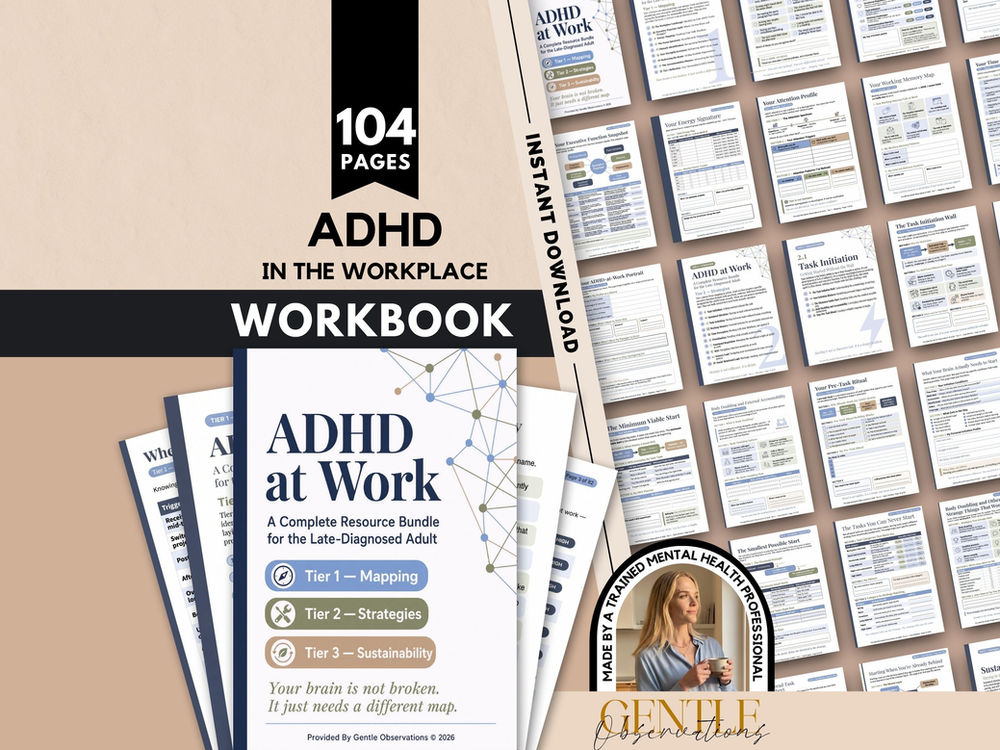
This is what led me to create the ADHD in the Workplace Workbook, a three-tier workbook resource for therapists working with late-diagnosed adults or adults who are beginning to wonder if ADHD is part of their picture.
The whole thing is structured around a principle I became fairly firm about while designing it: mapping before strategies. You don't start with the tools. You start with understanding the specific brain in front of you.
Tier 1, Mapping opens with the Workplace field, which is essentially a normalising checklist of sixteen specific workplace experiences that show up in adults with ADHD. Things like email overwhelm and inbox paralysis, the shame after a productive day that felt fake, the email being drafted for three days. Clients circle what they recognise. And there's a reframe box right there: "This is not a list of flaws. It is a list of experiences that have a name."

That reframe matters. For a lot of late-diagnosed adults, the first act of naming is therapeutic in itself.
The Workplace Friction Map comes next, and this is probably the most clinically functional page in the first tier. Clients rate ten specific domains, Focus and Attention, Sensory Overload, Time Blindness, Executive Function, Procrastination, Organisation and Systems, Emotional Regulation, Task Initiation, Meeting Challenges, and Communication Barriers, on a LOW / MEDIUM / HIGH scale. Then they identify their top three friction points, and those ratings direct them toward specific strategy sections in Tier 2. It's essentially a routing tool embedded in a worksheet.

The Executive Function Snapshot:
Maps eight EF domains in a table format. For each domain, including Working Memory, Task Initiation, Planning, Organisation, Time Management, Sustained Attention, Emotional Regulation, and Cognitive Flexibility, there are descriptors for when it works well, descriptors for when it struggles, and a 1-5 self-rating scale. Clients finish by naming their two most affected domains.

The specificity here is what makes it useful. A client who identifies Task Initiation and Working Memory as their primary domains gets a very different Tier 2 journey than someone whose highest friction is Emotional Regulation and Sensory Load.
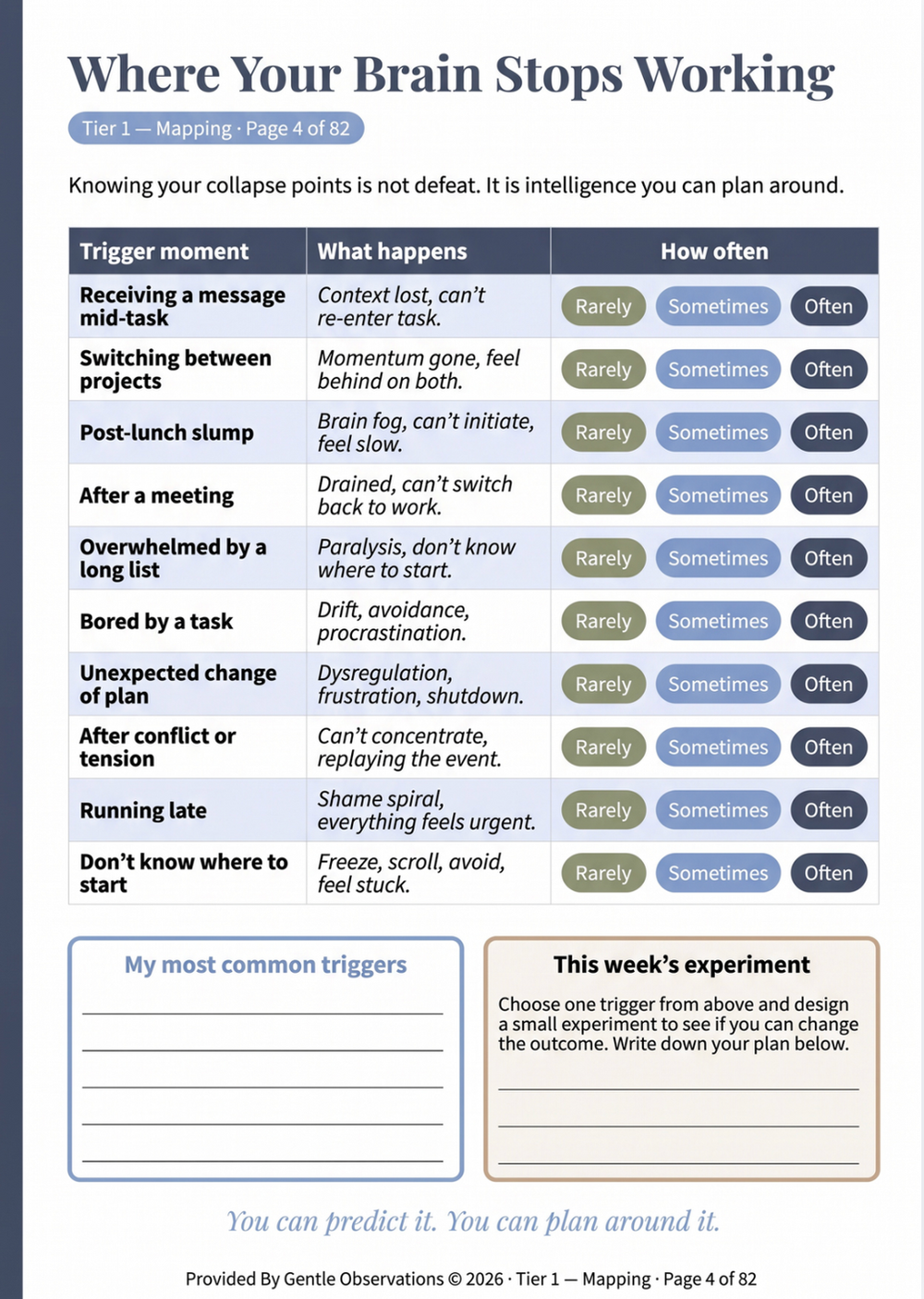
Where Your Brain Stops Working:
Is a trigger-mapping page with ten specific workplace collapse scenarios: receiving a message mid-task, switching between projects, post-lunch slump, unexpected change of plan, not knowing where to start. For each trigger, clients rate how often it happens, and there's a behavioural experiment prompt asking them to choose one trigger and design a small test to see if they can shift the outcome. Classic CBT structure, but fitted to the specific phenomenology of ADHD at work.
Your Energy Signature:
Is the page I keep coming back to in conversation with clinicians. Clients build a time-block map of their energy levels and focus quality across the day, rating each two-hour slot as high, medium, or low, and identifying what kind of work suits each window. Then there's a weekly pattern tracker. And then, the section I think is most clinically rich: distinguishing between "when I am genuinely available" and "when I am performing availability."

That distinction is worth sitting with. Adults with ADHD often spend enormous amounts of effort looking productive at times when their executive function is basically offline. They check emails during their best focus window because it feels manageable and safe. They put off the hard task until 4pm when they have nothing left. And they cannot understand why they're exhausted and still behind.
The ADHD Strengths Inventory covers nine domains: Hyperfocus, Crisis Competence, Creative Thinking, High Empathy, Entrepreneurial Drive, Rapid Learning, Authenticity, Persistence, and Humour and Warmth. Clients identify where they see these showing up at work, what they've been told they're good at, and where they want to use these traits more intentionally.
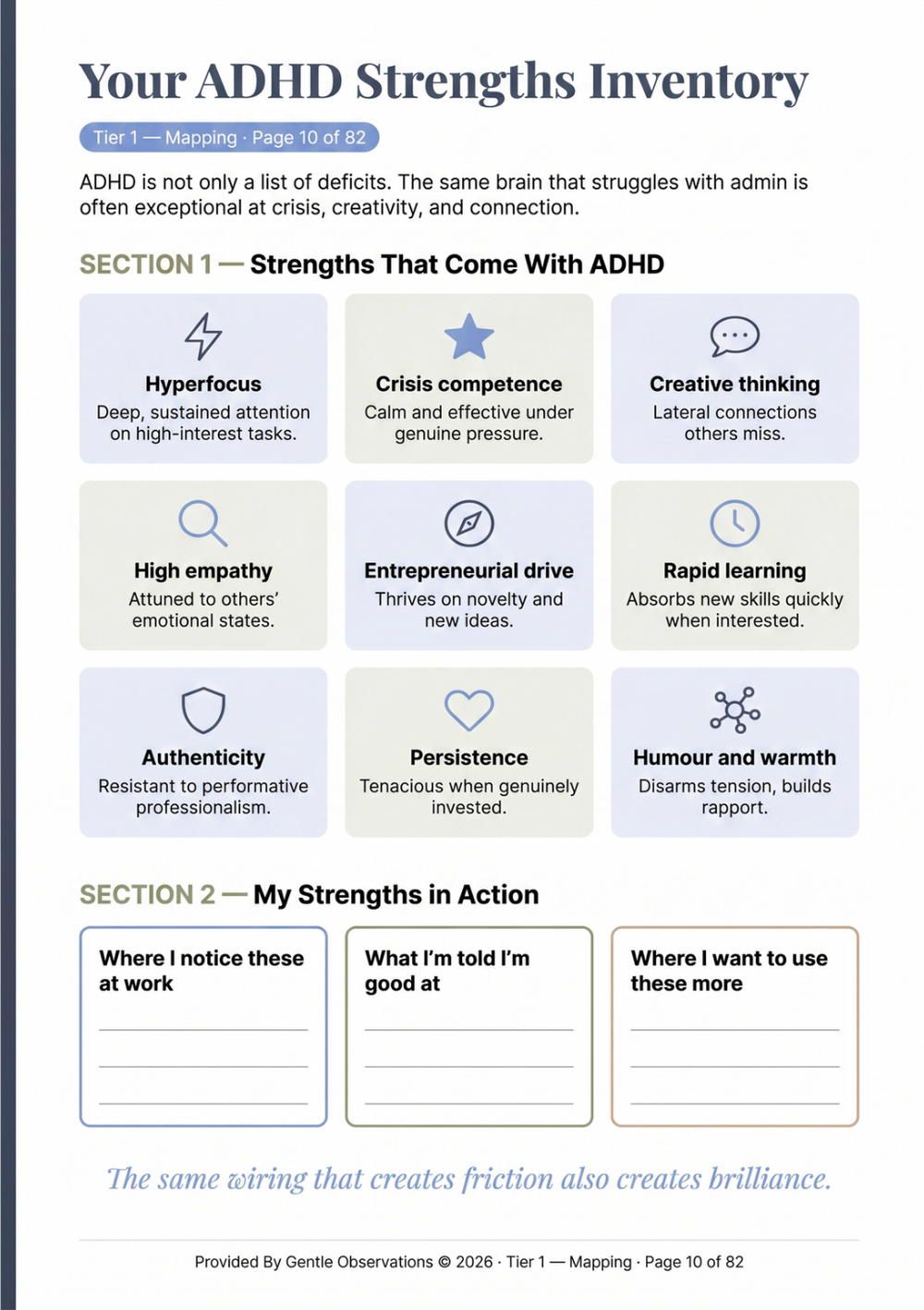
The research is fairly clear that a strengths-based approach to ADHD isn't just therapeutic fluff. Creative thinking, hyperfocus, and high empathy are genuine assets in many work contexts, and helping clients identify where those traits have already served them can shift something fundamental about how they hold their own story.
The whole Tier 1 closes with the ADHD-at-Work Portrait, a synthesis page that pulls together top three friction points, strongest and most affected EF domains, best focus windows, biggest triggers, and what the client needs in terms of environment, structure, and support. There's a section for what they want their manager to know. And a section for what they want to stop apologising for.
Clinical Callout: When a client presents with chronic workplace difficulties, consider holding an ADHD hypothesis early. Specifically: difficulty initiating tasks that don't have inherent interest or urgency, inconsistent performance that doesn't map onto effort, and a pattern of conflict or tension in workplace relationships that seems disproportionate to the events. You don't need to diagnose in practice. But the frame shapes what you listen for.
Tier 2, Strategies targets specific executive function domains based on the Tier 1 routing. The Task Initiation section alone spans five subsections: the Task Initiation Wall, Initiation Blockers, the Minimum Viable Start, Body Doubling and Accountability, and the Pre-Task Ritual.
The Minimum Viable Start is one of those concepts that sounds almost too simple until you see it work. The MVS has three criteria: it must be one specific physical action, it must take under two minutes, and it must require no decision-making. There are examples for different task types (writing, email, admin, project work, meeting prep), and then a planner where clients name the task they're avoiding and build their own MVS for it.
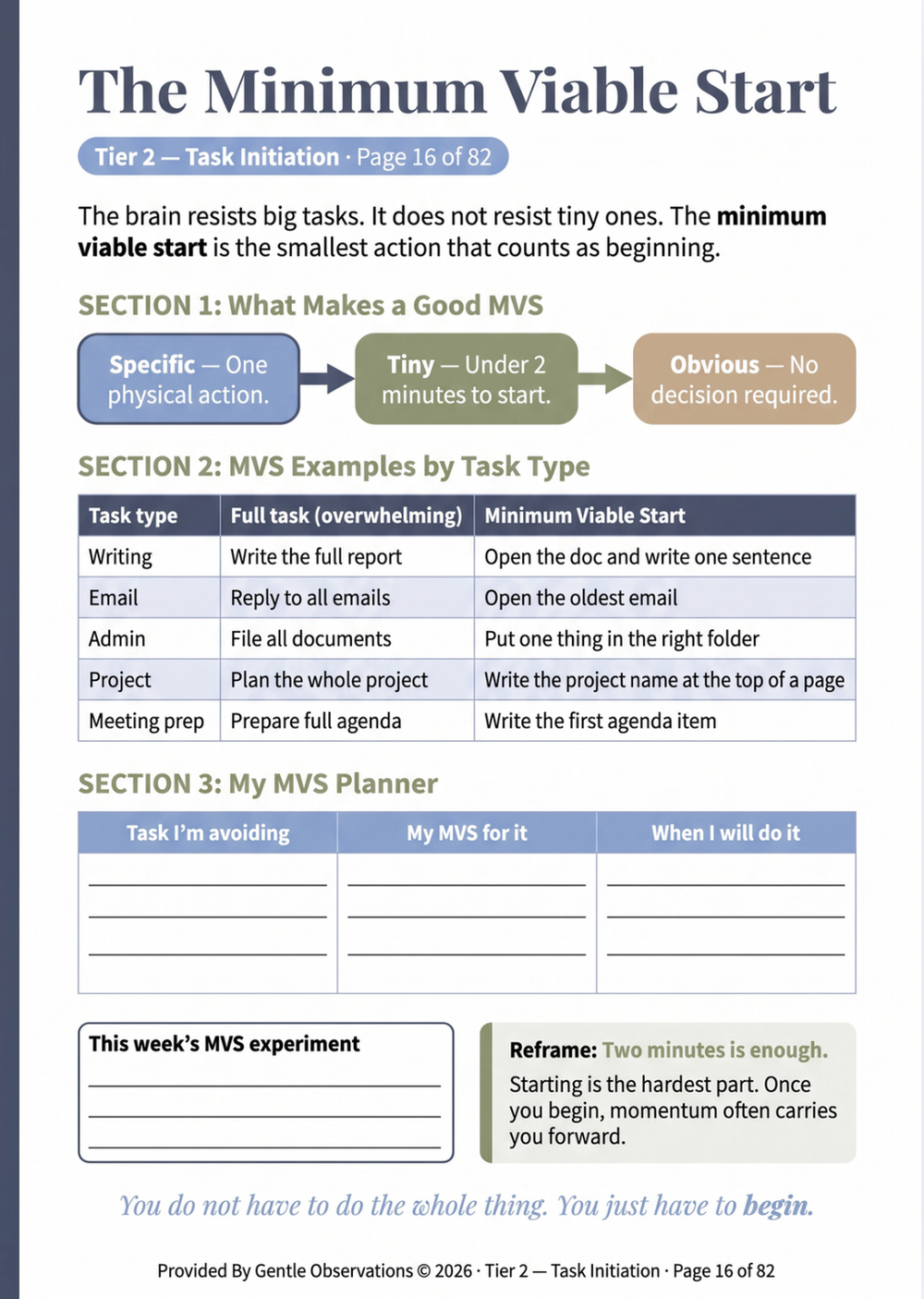
The reframe at the bottom of that page: "Two minutes is enough. Starting is the hardest part." Which the research on activation gap actually supports.
The Bigger Picture
There's something worth saying directly about late diagnosis and workplace shame.
The clients who come to therapy in their thirties and forties and fifties having just received an ADHD diagnosis often aren't in crisis because of the diagnosis. They're in crisis because of everything that happened before it. Two decades of being told they're not living up to their potential. The jobs they lost. The relationships strained. The private, relentless effort of trying to function like everyone else and never quite managing it.
The mapping work in this bundle is designed to give those clients something they often haven't had: a framework for understanding what their brain has actually been doing all along. And the strategies in Tier 2 are designed to work with that specific brain, not against it.The final line on the ADHD-at-Work Portrait synthesis page reads: "You are not a problem to be fixed. You are a brain to be understood."
That's the clinical goal, really. Not compliance with neurotypical workplace standards. Understanding.
About the ADHD In The Workplace Workbook
The ADHD In The Workplace Workbook: A Complete Resource Bundle for the Late-Diagnosed Adult is a three-tier structured workbook spanning 100 pages. Tier 1 (Mapping) includes nine sections covering the full ADHD-at-Work profile: the Workplace field, the Workplace Friction Map, Executive Function Snapshot, trigger mapping, energy profiling, attention and working memory mapping, time perception, strengths inventory, and the ADHD-at-Work Portrait synthesis page.
Tier 2 (Strategies) covers ten specific executive function domains including task initiation, sustained attention, task switching, working memory, time perception, prioritisation, emotional regulation, RSD, sensory load, and social-relational load. It can be used as a therapist-facilitated resource, assigned as structured homework between sessions, or used as a guided self-directed workbook. Grounded in CBT, ACT, and executive function scaffolding frameworks.
 ADHD In The Workplace Full Workbook$10.00Buy Now
Free Resources for Therapists
The screenshots throughout this article are pages taken directly from The ADHD In The Workplace Workbook the What ADHD Actually Looks Like At Work, The Workplace Friction Map, the Your Executive Function Snapshot, the Where Your Brain Stops Working and more are all yours to reference and use with clients. Additional clinical downloads, including free worksheets and handouts, are available in the Gentle Observations FREEBIE LIBRARY.

All resources, and every other clinical tool across every major presenting theme, are available inside the Therapy Resource Library. New resources drop every Monday: [JOIN THE LIBRARY]
FAQ
How do I raise the possibility of ADHD with an adult client who hasn't been assessed? You don't need to diagnose or formally suggest ADHD. Naming patterns you've noticed ("I'm curious about this pattern of getting really stuck on starting tasks even when you want to do them") and psychoeducating about executive function as a concept can open the conversation without pathologising. A screening tool like the Adult ADHD Self-Report Scale can be used collaboratively as part of that exploration.
Can I use behavioural strategies for ADHD in therapy without specialising in ADHD? Yes, with some caveats. Strategies that target executive function, like the Minimum Viable Start, body doubling, external memory systems, and energy scheduling, are practical tools that sit well within a general therapy framework. If a client needs a formal assessment, you'd refer for that. But supporting workplace functioning behaviourally doesn't require specialist ADHD training.
What's the difference between ADHD coaching and ADHD-informed therapy? Coaching typically focuses on goal-setting, accountability, and skill-building without the psychological depth. Therapy can do all of that while also addressing the shame, self-concept disruption, and relational patterns that come with decades of undiagnosed ADHD. The two are complementary. The strategies in the Tier 2 section of this bundle are therapy-compatible and can be integrated without needing to refer out for coaching.
References:
Sarkis, E. (2014). Addressing attention-deficit/hyperactivity disorder in the workplace. Postgraduate Medicine, 126(5), 25-30.
Kessler, R.C., et al. ADHD at the workplace: ADHD symptoms, diagnostic status, and work-related functioning. Journal of Neural Transmission (Vienna).
More ADHD Therapy Resources for Practitioners
 Executive Functioning ADHD Workbook for Adults & Teens$10.00Buy Now
 ADHD Emotions/Sensations Wheel Poster$3.00Buy Now
 ADHD Super Power Cards For Teens$3.00Buy Now
 Masking Workbook for ADHD & ASC Teens and Adults$6.00Buy Now
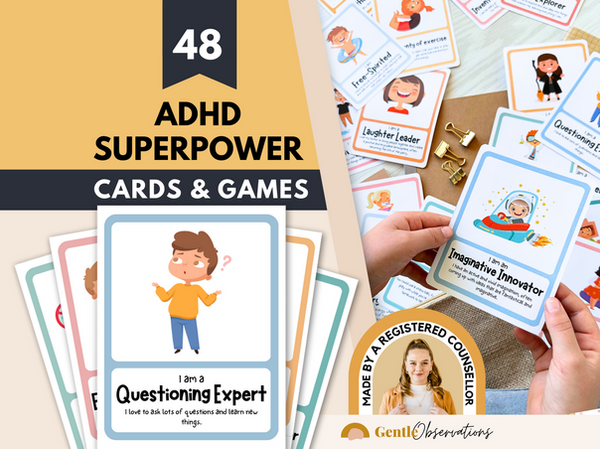 ADHD Superpower Cards$3.00Buy Now