
7 Emotionally Focused Therapy Techniques for Couples Therapists
7 min read
Seven practical EFT techniques for couples work, from mapping the negative cycle to the softening moment. Includes a free worksheet and a done-for-you workbook for therapists.
Two people sit across from you. They have done this before; the same argument, the same silence, the same drive home where neither of them speaks. By the time they're in your room, they've each privately decided the problem is the other person.
Emotionally Focused Therapy, developed by Sue Johnson, starts from a different premise. The problem is the cycle. Not the person. And the cycle can be interrupted.
EFT is grounded in attachment theory: the idea that adults have the same fundamental need for a secure emotional bond as children do. When that bond feels threatened, people protest through pursuit, withdrawal, criticism, silence. The protest is always a reach for connection, even when it looks nothing like one.
These seven techniques map the core clinical moves in EFT couples work, drawn from the framework used in the Finding Each Other Again workbook. You do not need formal EFT training to use them. You need a willingness to go beneath the surface of what couples are arguing about, and stay there long enough to find what they are actually asking for.

1. MAP THE NEGATIVE CYCLE WITH THE COUPLE
The first move in EFT is externalisation: helping the couple identify the pattern that keeps pulling them apart so they can look at it together, rather than at each other.
Every couple has a version of the negative cycle. A trigger lands; feeling ignored, criticised, misunderstood, or suddenly distant. One partner responds with a protest behaviour: escalating, pursuing, criticising, or going quiet. The other responds to the protest, not to the need underneath it. Distance grows. Both partners feel more alone than before.
The two most common patterns are pursue-withdraw (one escalates to stay in contact while the other shuts down to manage overwhelm) and withdraw-withdraw (both protect, and the surface looks like resignation or indifference).
The clinical task is to map this with the couple until they can see their own version clearly. When the couple can say "we're in the cycle again" rather than "you always do this," the frame has shifted. The cycle is the problem. That shift is foundational to everything else.

2. USE THE EMOTIONAL DESCENT TO GO BENEATH THE PROTEST
Once the cycle is named, the work moves inward. The protest behaviour, the anger, the withdrawal, the criticism — is not the primary emotion. It is protecting one.
In EFT, emotions are understood in layers. Secondary emotions are the reactive, protective ones: anger covering fear, withdrawal covering grief or shame. These are the emotions that arrive in session and land as attack or distance. Primary emotions are the raw, immediate ones underneath: fear, grief, shame, longing, hurt, tenderness. When these are expressed, they invite connection. When the secondary emotion is expressed, it tends to trigger more cycle.
The Emotional Descent is a five-step process for moving from the surface to what is underneath:
Step 1: Name the surface emotion (anger, irritation, shutdown)
Step 2: Name what the client did with it (went quiet, raised their voice, left the room)
Step 3: Name the story they were telling themselves ("they don't care," "I'm too much")
Step 4: Find the softer feeling underneath (fear, grief, longing, shame)
Step 5: Name the attachment need — what they were actually needing in that moment
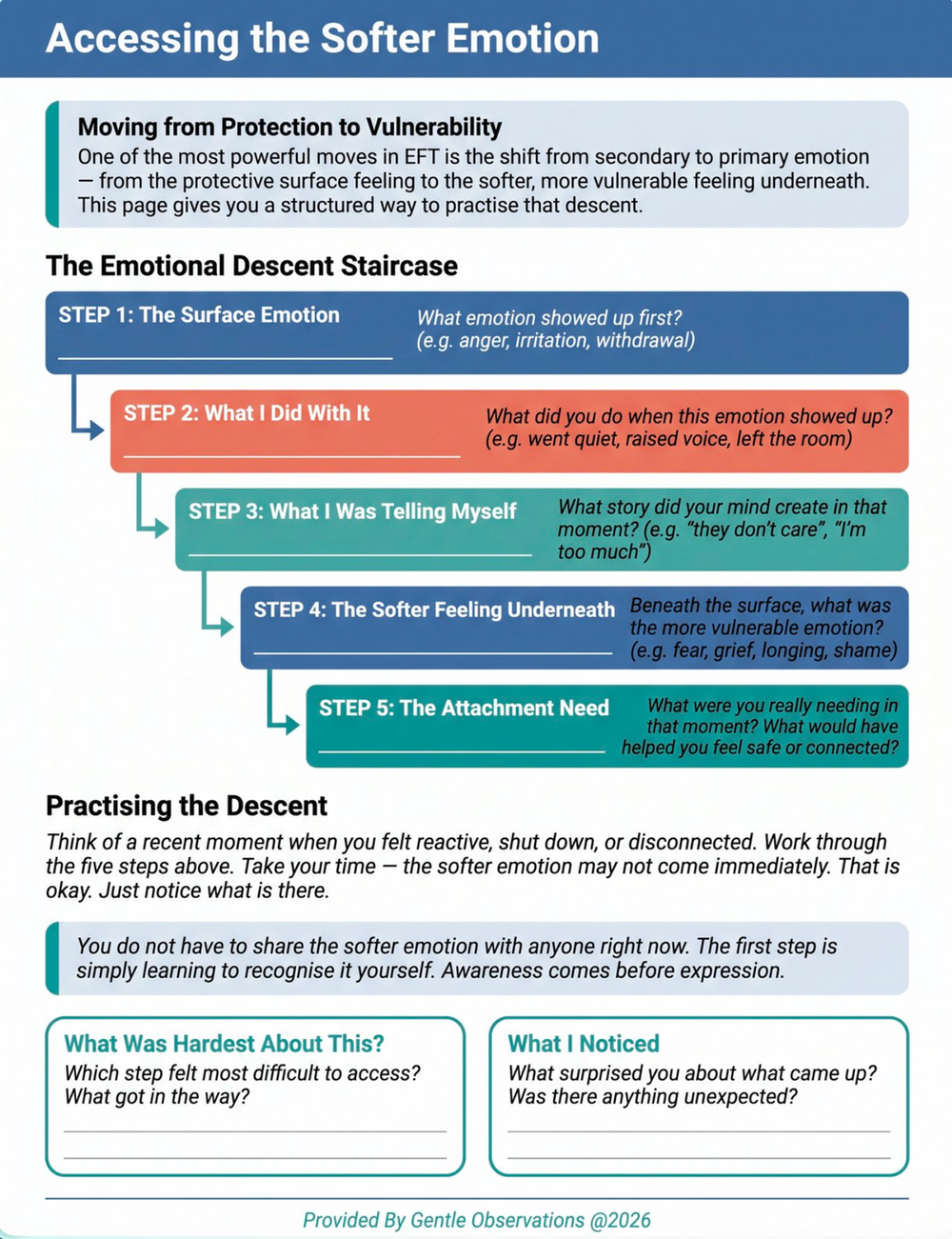
This is slow work. The softer emotion does not always come immediately. Many clients have never been asked to do this, and Step 4 in particular can be difficult to access. The principle worth holding is that awareness comes before expression. You are building vocabulary before expecting the conversation.
3. NAME ATTACHMENT NEEDS WITH PRECISION
Beneath the softer emotion is the attachment need. And beneath many attachment needs is a specific fear: usually some version of abandonment, rejection, or not being enough.
Fear of abandonment shapes relationship behaviour in recognisable ways: hypervigilance (scanning for signs of withdrawal), people-pleasing (suppressing needs to avoid driving the person away), clinging (seeking constant reassurance), emotional shutdown (disconnecting to avoid the pain of potential loss), testing behaviour (pushing to see if the other person will stay), and pre-emptive leaving (ending things first).
These are adaptive responses, often formed long before this relationship. The clinical task is to help each partner begin to see their own behaviour through this lens, and their partner's behaviour through it too. When a partner goes silent, they may be protecting from overwhelm. When a partner escalates, they may be reaching for reassurance in the only language they have.
The Attachment Needs inventory in the workbook lists 18 specific needs: to feel truly seen, to feel safe to be vulnerable, to feel chosen, to feel heard, to feel forgiven, to feel like a team, to feel enough. Using this in session gives couples a precise vocabulary for what they are actually asking for, which is often very different from what comes out in conflict.

4. DECODE BIDS FOR CONNECTION
A bid for connection is any attempt to engage with another person emotionally. Most bids are not direct. They arrive disguised as complaints, mundane comments, or silence, and they are easy to miss.
The Bid Decoder maps the hidden message underneath the surface behaviour:
"You never listen to me" means: Please pay attention to me. I need to feel heard right now.
"Fine. Whatever." means: I am hurting and I do not know how to say it. Please notice.
Sighing loudly in the next room means: I am struggling and I want you to come and check on me.
"Did you see that thing on the news?" means: I want to share something with you. I want to feel connected.
Going quiet and withdrawing means: I am overwhelmed. I need you to come toward me gently.
Each bid receives one of three responses: turning toward (acknowledging the bid and responding with presence), turning away (ignoring or missing the bid entirely), or turning against (responding with irritation or criticism). Over time, the pattern of how a couple responds to bids shapes the entire emotional climate of the relationship.
Couples in distress often turn away or against not because they do not care, but because they have stopped being able to read what the bid is actually about. Teaching them to name the bid, and the response, is one of the most transferable tools from EFT. A small turn toward — putting the phone down, making eye contact, saying "tell me more" — is clinical data. It is evidence the cycle can be interrupted.

5. TEACH THE APOLOGY THAT ACTUALLY HEALS
Not all apologies repair. Some close the wound. Others reopen it.
The difference lies in whether the apology acknowledges the other person's emotional experience and takes genuine responsibility, without deflecting or minimising.
The apology that does not heal sounds like:
"I'm sorry you feel that way."
"I'm sorry, but you were also..."
"I didn't mean it like that."
"You're too sensitive." "
I'll try to be better."
This pattern splits responsibility, prioritises intent over impact, and offers nothing concrete to change.
The apology that heals sounds like:
"I can see that what I did really hurt you."
"I take responsibility for my part in this."
"I understand why that felt hurtful to you."
"I imagine that felt really lonely."
"I want to understand what I can do differently."
This pattern acknowledges specific impact, owns the behaviour without caveats, validates the emotional experience, and invites dialogue about real change.
What shifts with the second type is not just the words. It is what the other person hears. Safety is restored. Connection becomes possible again.
Many couples have been doing version one their entire relationship without knowing there was a version two. Introducing this distinction explicitly in session, with the comparison visible, is worth the time it takes.

6. SUPPORT THE SOFTENING MOMENT
The softening is one of the most significant moments in EFT work. It is when a person moves from their defended, protective position and allows their more vulnerable self to be seen.
The defended position sounds like:
"I do not need anything from you."
"Fine. Whatever."
"Just leave me alone."
"I am not angry, I am fine."
The body matches: jaw tight, shoulders raised, arms crossed.
The softened position sounds like:
"I am scared you do not want me."
"I miss you and I do not know how to say it."
"I need to know I matter to you."
"I am hurting and I need you close."
The body matches too: shoulders dropped, arms open, breath deeper, face present.
The softening is not weakness. It is one of the bravest things a person can do in a relationship. And it is the moment that creates the deepest connection, not because vulnerability is romantic, but because it is information. When one partner softens, the other person finally hears what has been underneath all the escalation or withdrawal.
Not every client is ready to soften in session, and it should not be rushed. The earlier stages of EFT work build the emotional safety that makes softening possible. The therapist's job is to hold the space, stay close to the process, and let the moment come.

7. BUILD THE POSITIVE CYCLE
The negative cycle pulls partners apart. The positive cycle draws them closer. It grows when one partner reaches with vulnerability, the other responds with presence, connection builds, trust deepens, and the next reach becomes a little easier than the last.
This is the EFT goal: not the absence of conflict, but a new shared language and a reliable path back to each other when things get hard. The positive cycle does not replace arguments. It changes what happens after them.
The Our Positive Cycle worksheet maps the personalised version for each couple: what it looks like when they reach, when they respond, when they connect. Completing it toward the end of the therapeutic work becomes an anchor, a concrete reminder of what is possible when the pattern is working with them rather than against them.
A relationship is not something you find. It is something you choose to build, every single day. The positive cycle is the structure that makes choosing it possible.

The Finding Each Other Again workbook takes these seven techniques and builds a full clinical arc around them: 42 exercises across 8 stages, from mapping the negative cycle in session one to building the positive cycle in the later work.
It is in the Library alongside 8000+ other done-for-you clinical resources. [Join the Library →]
MORE COUPLES THERAPY TOOLS IN THE LIBRARY
 Couples Communication Worksheets$5.00Buy Now
 Managing Resentment in Relationships$5.00Buy Now
 Attachment Styles Psychoeducation$1.50Buy Now
 Attachment Styles Self-Assessment$3.00Buy Now
 Reacting Vs. Responding Worksheets for Improved Communication Skills$2.00Buy Now
I'm Jemma, a professionally trained mental health professional and digital product creator. I've built a profitable therapy resource business from my clinical expertise. I teach other therapists to do the same, using AI tools that are safe, practical, and built for the way clinicians actually think.