
Why Sibling Fights Keep Repeating (And the Framework That Actually Changes It)
9 min read
Two children. One broke what the other was building. There is crying, shouting, a story you have already heard three times in as many weeks. You step in, de-escalate the situation, and when things settle, you turn to whoever caused the damage and say: "Now apologise."
The word gets said. Monotone, reluctant. Everyone moves on.
And next week it happens again.
This is not a parenting failure or a behaviour problem; it happens when conflict ends before it has actually been resolved. This post walks through a clinical framework for working with sibling conflict: what is driving it, why the standard responses keep it going, and what actually interrupts the cycle.
THE SORRY TRAP
When a child is forced to apologise under pressure, the emotional experience driving the behaviour goes entirely unprocessed. The child learns that saying one particular word ends the adult's attention and restores the surface peace. The underlying hurt, shame, or unmet need stays exactly where it was.
This is the Sorry Trap, and it runs on a predictable cycle: forced apology, resentment or shame, suppressed anger, the same conflict again.
The reason siblings get stuck in repeating patterns is not that they lack the capacity for repair. It is that the conflict keeps ending before repair has actually happened. The surface tension dissolves and everyone moves on before the emotional layer underneath it gets any attention.
Understanding this is the shift that makes everything else in sibling work possible. The goal is not to stop the fight. The goal is to teach the child, over time, how conflict actually ends.
WHAT IS BENEATH THE FIGHT
Most sibling conflicts look like disagreements on the surface. She took my stuff. He always gets more. She won't leave me alone. These feel like the problem. They are not the problem.
Beneath the visible behaviour is typically a trigger: something specific that set things off. Being teased, being ignored, having things taken, feeling like the sibling always gets their way. These are workable. The child can name them once they understand what they are actually responding to.
Beneath the trigger is the root: an emotion that had not been regulated before the conflict began, a need for parental attention, a nervous system that was already at capacity before the sibling said a word.
Working at the behaviour level — punishing the hitting, demanding the apology — leaves the rest of the structure completely intact. The same trigger will hit again tomorrow. The same nervous system will respond the same way. The same fight will happen.
This iceberg model matters practically because it tells you where to intervene. For a child whose root is unregulated emotion, regulation comes before conversation. For a child whose root is feeling invisible to the parent, a repair that does not address that will not hold. For a child whose trigger is comparison and fairness, those specific themes need direct clinical attention.

The What Lights My Fuse worksheet in the Sibling Rivalry Workbook is the entry point for this work. It moves children from "she's annoying" to something specific and workable. That specificity is what makes the rest of the intervention possible.
FROM REFEREE TO MEDIATOR
The most significant shift in sibling conflict work is not a technique. It is a role change.
A referee decides who was right and who was wrong, dictates the outcome, and restores order. "Hey, you two. Stop that right now." It stops the fight. It builds no skills. And it places the adult permanently in the middle of every conflict because the children have never been taught to resolve one without them.
A mediator does something different. They listen to both sides. They validate each child's experience without picking a winner. They calm the nervous systems before they attempt anything cognitive. And then they guide the children toward resolving the conflict themselves. "I can see you're both upset. Let me help you figure this out."
The distinction that matters clinically is this: the referee's intervention ends the conflict. The mediator's intervention teaches children how conflict ends. The first approach is faster. The second one is the one that eventually isn't needed anymore.
The Referee to Mediator slide deck lays out the full shift in three stages:
Regulate (de-escalate the nervous system before attempting anything verbal),
Relate (validate both sides, listen actively), and
Resolve (guide the problem-solving, hand the power back to the children).
In that order. Always.
The most common error in sibling work is skipping to Resolve before Regulate has happened. A nervous system that is still activated cannot engage in genuine problem-solving. What it can do is agree to end the interaction quickly, which produces a surface resolution that will unravel by tomorrow.

THE FEELINGS THERMOMETER
For the Regulate stage to work, children need language for what is happening in their body. This is not a given, especially for children under 10 who have limited emotional vocabulary and limited interoceptive awareness.
The Feelings Thermometer gives children a concrete scale.
At the bottom:
Cool and Calm — settled, easy, connected.
Moving up:
A Little Warm — starting to feel something, body is beginning to react.
Getting Hot — activated, harder to think clearly, the feeling is in the body now.
At the top:
Boiling Hot — flooded, unable to process, conversation will not land.
Children use the scale alongside a body map to locate where the emotion lives physically. Tight chest, clenched fists, hot cheeks, stomach flip.
Making the invisible visible is often the thing that creates enough distance from the emotion for the child to begin to work with it.

The Feelings Thermometer works as a session check-in, as a between-session tracking tool, and as a shared language between siblings. "What colour are you right now?" is a question that can stop a conflict before it escalates, if the child has practised using it enough times in calm conditions first.
For children who have difficulty naming emotion, this worksheet is often the entry point into every other piece of the work.
PRACTICAL PHRASES THAT BUILD BRIDGES
The Referee to Mediator shift requires a different vocabulary.
These are the phrases that sit on the mediator side of the line.
For validating without picking a side: "I can see you're both really upset right now." This names the shared experience rather than assigning fault. It is also true, which matters because children call out dishonesty immediately.
For neutral reflection: rephrasing heated accusations into felt experience. "He's so mean" becomes "You're frustrated that he doesn't want to share right now." The feeling is reflected without the attack on the sibling being amplified.
For perspective prompts: "It sounds like you felt she did it on purpose. Do you want to tell her what happened from your perspective?" This opens a two-sided conversation without the adult having to adjudicate.
For holding the space: "I'm not going to tell you who was right. I'm going to help you both figure out what happens next."
For younger children or children who are flooded: "What colour are you right now?" This re-routes from accusation to body-based awareness and gives you information about readiness for conversation.
The Two Sides of the Story worksheet (Worksheet 4 in the workbook) makes this structural.
Each child fills in their own side — what happened, what they felt, what they need.
Then there is a bridge question at the bottom: "One thing we probably both felt was..." This single question is often where the work actually happens, because it asks each child to consider a shared experience without requiring them to admit fault.

THE APOLOGY BLUEPRINT
Guided remorse is the repair process that actually interrupts the Sorry Trap.
Rather than asking for a word, the adult walks the child through four questions:
What did I do?
How did it make the other person feel?
What should I have done differently?
What will I do next time?
In the workbook, this is Worksheet 13: The Apology Blueprint. Children write their way through each step. The writing matters. It slows the process down enough for something real to happen, and it produces something concrete that the other child receives rather than just a word said into the air.
What emerges is usually more specific, more honest, and more genuinely connective than anything a forced apology produces. "I took your Lego piece without asking and that made you feel really frustrated and like I don't care about your things" is a different interaction than "sorry."
The Apology Blueprint does not require that the child feel remorse before they begin. It asks them to think their way toward it. For many children, the empathy arrives during the process rather than before it.
A forced apology teaches a child that one word ends conflict. Guided remorse teaches a child how conflict ends. Those are different things to carry into adulthood.

BEFORE THE FIGHT: THE CALM-DOWN PLAN
One of the most clinically useful pieces of sibling work is building the regulation plan before the conflict happens, not during it.
A child who is at Boiling Hot cannot engage with their calm-down plan. Their access to it depends entirely on their state. The intervention window is the calm space before the next conflict, not the moment of the fight itself.
The Calm-Down Plan worksheet (Worksheet 21) walks children through five steps:
Notice It (identify the early physical cues — "my hands start to tighten"),
Name It (what am I feeling?),
Pause (create a physical gap before responding),
Cool Down (go to the plan),
Come Back (re-enter the conversation when ready).
The plan is pre-built in session, then practised in calm conditions, then gradually becomes accessible in more activated states as it gets embedded.
For children with higher baseline activation or complex histories, this process takes time. The plan is worth building anyway because the repetition is the point — each time the child uses it in low-stakes conditions, they are increasing the likelihood it will be accessible when the stakes are high.
The distinction between My Cool-Down Toolbox (Worksheet 6, which lists general tools) and My Calm-Down Plan (Worksheet 21, which is a personalised five-step sequence) matters practically. The toolbox is a menu. The plan is a sequence the child knows by heart. The plan is what gets used under pressure.
FAIR VS. EQUAL: THE DISTINCTION THAT CHANGES EVERYTHING
One of the most frequently presenting themes in sibling conflict is fairness. "It's not fair." "She got more." "Why does he get to stay up later?"
Most adults instinctively reach for equality: giving each child the same amount, the same time, the same rules. This makes sense as an attempt to resolve the complaint. It does not address what the child is actually asking.
Fairness and equality are not the same thing.
Equality means everyone gets the same. Fairness means everyone gets what they need to have an equal opportunity.
The Glasses Rule captures it simply: some children need glasses to see and others do not. Giving everyone glasses would be equal. Giving glasses only to the children who need them is fair.
The pizza slice version in the workbook makes this tangible: equal slices are the same size; fair slices are the right size for the person receiving them. A five-year-old and a fourteen-year-old do not need equal bedtimes to be treated fairly.
This distinction is worth teaching directly to children who keep returning to fairness complaints, because often those complaints are really about something else: feeling seen, feeling that their needs are recognised, feeling that the parent understands their specific situation rather than applying a blanket rule.
When a child understands that fairness is about needs, the conversation can move from accounting ("she got three minutes more") to something more workable.

DOWNLOAD: FREE SIBLING PEACE INFOGRAPHIC BUNDLE
Three visual resources for use with children, families, and in your own practice:
Fairness and Friendship: A Kid's Guide to Peace
The equality vs. fairness distinction, the path to resolution, and the peace tool choices. Child-facing and shareable with families.
Finding Peace Together: My Sibling Toolbox
A two-step process for children: find your calm first, then talk it out. Covers breathing, the calm-down kit, "I" statements, and the conflict resolution cube.
The Sibling Peace Guide: From Referee to Mediator
The mediator mindset, the resolution toolkit, and a parent action guide for different levels of conflict intensity (Brewing Tension, Active Argument, High Volatility). Adult-facing.
https://www.gentleobservations.com/all-freebies
MORE SIBLING RIVALRY RESOURCES IN THE LIBRARY
Sibling Rivalry Worksheets for Parents and Practitioners: 22 structured worksheets covering the full arc of sibling conflict for children aged 6 to 12, including everything covered in this post. Built around CBT, emotion coaching, and narrative therapy. Includes a practitioner guide, a feelings word wall, and a family agreement page.
https://www.gentleobservations.com/product-page/sibling-rivalry-workbook-for-kids-ages
 Sibling Rivalry Workbook for Kids Ages$4.00Buy Now
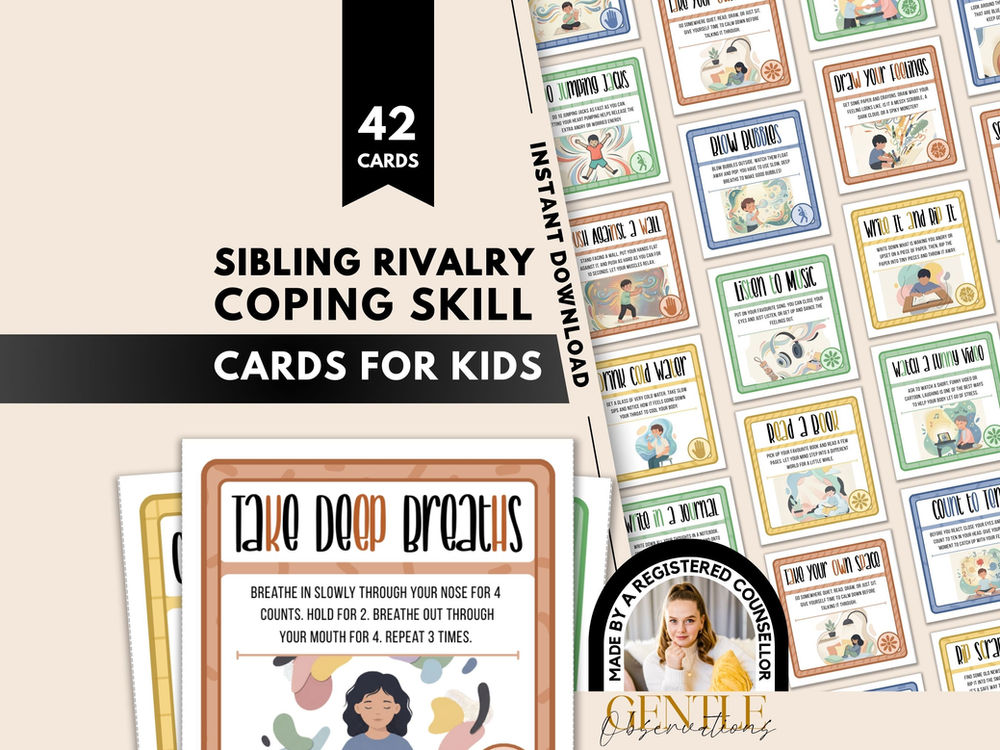
Sibling Rivalry Coping Skill Cards: 30+ body-based, cognitive, movement-based, and grounding tools in card format. Organised by category, session-ready, designed to be handed directly to clients or used to build a calm-down kit.
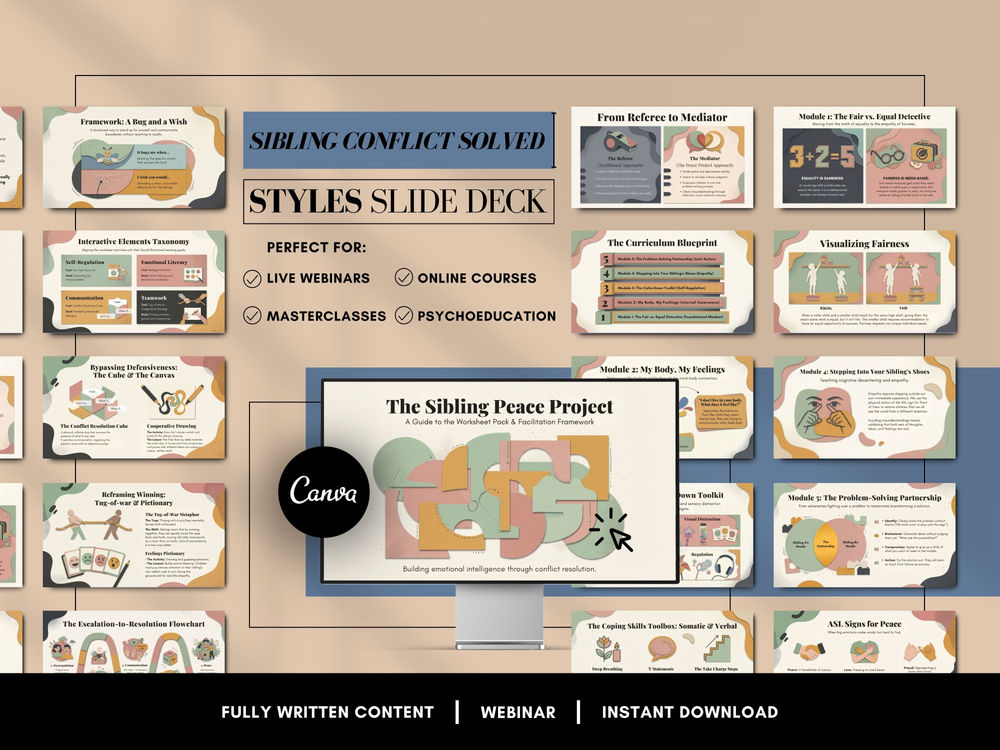
The Sibling Peace Project Slide Deck and Referee to Mediator Slide Deck are also included in the Library.
All of the Sibling Rivalry resources are inside The Therapy Resource Library, alongside 1000+ other clinically grounded, session-ready resources. If you want everything in one place, this is where it lives.
[Join the Library →] https://www.gentleobservations.com/therapy-resource-library
Jemma (Gentle Observations Team)

I'm Jemma, a professionally trained mental health professional and digital product creator. I've built a profitable therapy resource business from my clinical expertise. I teach other therapists to do the same, using AI tools that are safe, practical, and built for the way clinicians actually think.